

Blog
Best Commercial Meat Slicers: How to Choose for Your Kitchen


The best commercial meat slicer is the one that matches what you slice, how often you slice it and how easily your crew can clean it. For most delis, sandwich shops and restaurants that means a 10″ to 13″ gravity-feed slicer with a belt or gear drive, a solid blade guard and a carriage that comes apart for washing. This guide walks through the features that matter, the brands we carry and how to choose.
Babak Food Equipment carries a wide selection of commercial meat slicers from several makers, and we are an authorized Eurodib dealer. If you would like help comparing models, our team in Burnaby can walk you through them.
What makes a meat slicer “best” for a commercial kitchen?
There is no single winner, because a hotel breakfast line and a busy deli counter ask very different things of a slicer. Five questions narrow the field quickly:
- What will you slice? Deli meats and cheese are easy. Boneless roasts, prosciutto, salami and partly frozen product are harder on the motor and the blade.
- How many hours a day will it run? Light use for an hour or two suits a lighter machine. Hours of continuous slicing call for a heavy-duty motor and a drive that will not stretch or slip.
- Who will use it? A machine used by many staff members needs clear guards and simple controls.
- How will it be cleaned? A slicer that is hard to clean gets cleaned less often. Removable parts matter.
- Where will it sit? Check counter space, outlet type and clearance around the carriage travel.
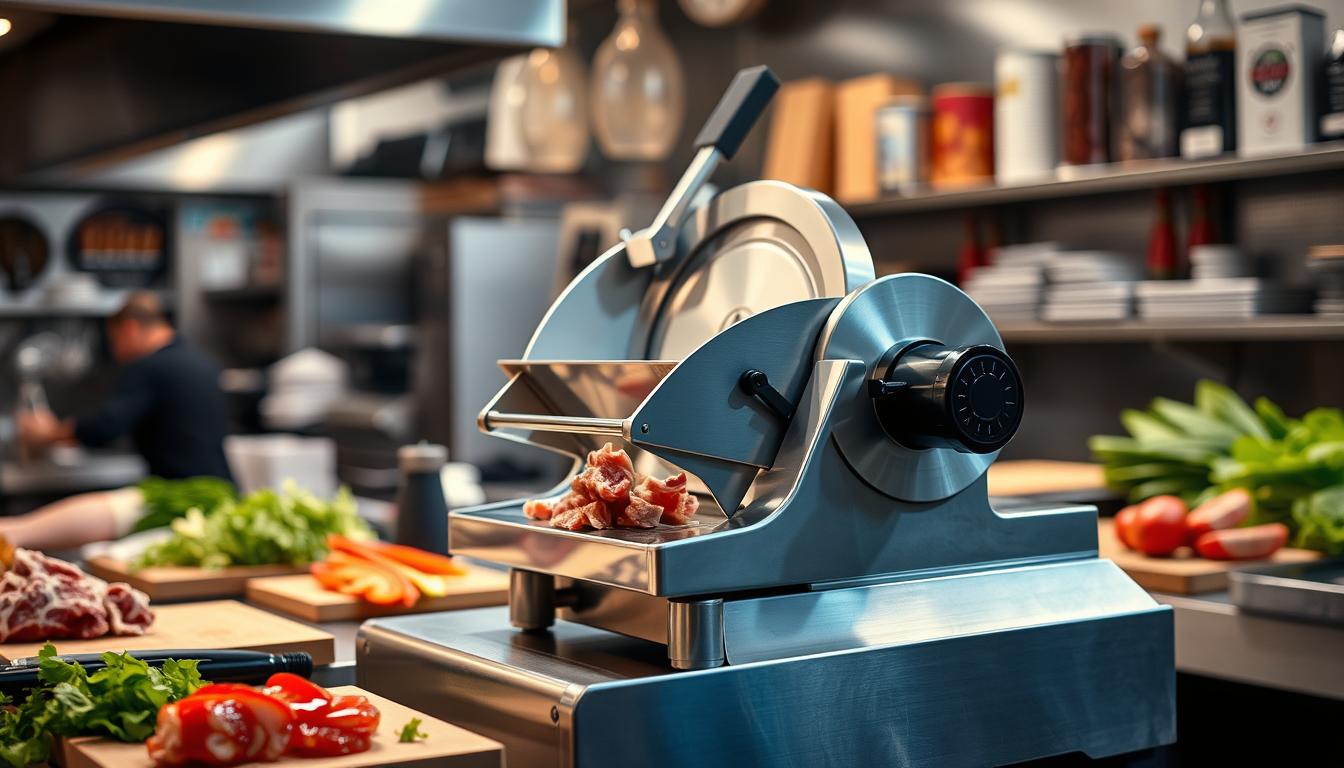
Blade size: 9″, 10″, 12″, 13″ or 14″?
Blade diameter decides how big a piece of product you can slice in one pass and how much throughput you get.
- 9″ to 10″: light to medium duty. Good for smaller cuts, cheese and low-volume sandwich service.
- 12″: the all-round choice for most restaurants and delis. It handles typical deli logs and roasts.
- 13″ to 14″: heavy-duty slicers for high volume and large product, such as full-size roasts and big sub rolls of meat.
If you are unsure, step up one size. A slicer that is slightly bigger than you need is easier on the motor than a smaller one working at its limit.
Motor power and drive type
Motor size is usually given in horsepower. Light-duty machines run on roughly 1/4 to 1/3 HP, while heavy-duty slicers go to 1/2 HP and above. More power helps with dense product and long runs.
The drive matters as much as the motor:
- Belt drive is quieter, absorbs shock and is easy to replace.
- Gear drive transfers power directly and holds up under sustained, heavy use.
Either can be a good choice. Pick based on volume and the product you slice, and ask us which models use which design.
Manual vs automatic slicers
On a manual slicer the operator pushes the carriage back and forth by hand. It costs less, takes less space and is perfect when slicing is occasional or when you want control over every slice. An automatic slicer moves the carriage on its own, which frees the operator to catch slices, stack them or prepare the next item. Automatic models suit high-volume delis, grocery counters and banquet prep where the slicer runs for long stretches.
Many automatic models can also be used in manual mode, which gives you flexibility for small jobs.
Gravity feed vs vertical
Most commercial slicers use a gravity feed: the carriage is tilted so the product rests against the gauge plate and feeds into the blade with its own weight. This setup is reliable and produces consistent slices. A vertical feed is more common in specialty applications. For a typical restaurant or deli, gravity feed is the right answer.
Safety features to look for
A slicer blade is among the sharpest tools in any kitchen, so safety features are not optional.
- A fixed ring guard around the blade edge.
- A gauge plate that closes fully when the thickness dial is set to zero.
- A blade guard and a product pusher or hand guard on the carriage.
- An interlock or a protected power switch, so the slicer cannot start by accident.
- Non-slip feet that hold the slicer steady during use.
Train every user, and keep a cut-resistant glove at the station for cleaning. Follow the manufacturer’s operating instructions and any workplace safety requirements that apply to your business.
Cleaning and sanitation
A slicer touches ready-to-eat food, so it has to be cleaned and sanitized on a regular schedule. In British Columbia, your local health authority, such as Vancouver Coastal Health or Fraser Health, sets the expectations for your premises, and your written sanitation procedures should say how and when the slicer is cleaned. Follow your health authority’s requirements and the manufacturer’s manual.
Features that make cleaning easier:
- A removable blade cover and sharpener.
- A carriage that detaches without tools.
- Smooth, sealed surfaces without deep crevices.
- An anodized aluminum or stainless steel body that resists corrosion.
Keep the cold chain in mind too. Refrigerated product, such as deli meat, should be held at 4 C (39 F) or colder, so do not leave a full log on the carriage for long periods. A nearby food prep refrigerator keeps product close and cold.
Brands we carry
We offer slicers from several respected makers, so you can compare by duty level and budget:
- Hobart and Centerline by Hobart: well-known names in commercial food service. Browse manual and automatic models from 10″ to 14″ blades. See the Hobart HS8N-1 13″ manual slicer for one example.
- Berkel: a classic name in deli slicing, with medium-duty and heavy-duty gravity-feed machines and prosciutto slicers. The Berkel X13-PLUS 13″ manual slicer is a good starting point for busy counters.
- Eurodib: manual and electric slicers, from compact models to larger machines. As an authorized Eurodib dealer, we can walk you through the line, including the HBS-300L electric meat slicer.
- Axis and Primo: practical options for cafes, sandwich shops and low to medium volume service, in 10″ to 14″ sizes.
- Avesta and Babak: medium-duty slicers in the 10″ class for smaller operations.
We also list used slicers from time to time. Check our used restaurant equipment category for current listings.
Rough price ranges in CAD
These are rough estimates for new equipment. They vary by brand, size and spec, and they are not Babak prices or a quote.
- Light to medium duty, 9″ to 10″: roughly $700 to $2,000.
- 12″ gravity-feed manual: roughly $1,500 to $3,500.
- 13″ to 14″ heavy duty or automatic: roughly $3,000 to $8,000 or more.
Request a quote for current pricing on the models you are comparing.
Best meat slicer for home use or a small business?
Some people searching for the best meat slicer want one for the home kitchen. We focus on commercial equipment, and for small food businesses a 10″ or 12″ commercial slicer is a sensible step up from a consumer model because it is built for repeated cleaning and daily use. Home-use appliances are not designed for that pace.
Slicer buying checklist
| Question | Light use | Medium use | Heavy use |
|---|---|---|---|
| Blade size | 9″-10″ | 12″ | 13″-14″ |
| Motor | About 1/4-1/3 HP | About 1/3-1/2 HP | 1/2 HP and up |
| Operation | Manual | Manual or automatic | Automatic |
| Typical user | Cafe, small sandwich shop | Restaurant, deli | Grocery, busy deli, banquet prep |
For more on putting a slicer to work, read our article on improving kitchen efficiency with a commercial meat slicer. If you also slice bread, see bread slicers, and for other prep jobs browse slicers and graters and meat prep equipment.
Frequently Asked Questions
What is the best commercial meat slicer?
It is the one that fits your product, volume and cleaning routine. For most restaurants and delis, a 12″ gravity-feed slicer with a belt or gear drive and good guards is the best balance of power, capacity and price.
Who makes the best industrial slicer?
Several makers build excellent commercial slicers. Hobart, Berkel and Eurodib are among the lines we carry. The best one for you depends on duty level, blade size and budget, so compare models rather than choosing by name alone.
What blade size do I need?
A 12″ blade covers most restaurant and deli needs. Choose 13″ to 14″ for large product and heavy volume, and 9″ to 10″ for light use.
Is a belt drive or gear drive better?
Both work well. Belt drives are quieter and easy to service. Gear drives handle sustained heavy use. Match the drive to how long and how hard the slicer will run.
How often should a meat slicer be cleaned?
Clean and sanitize it on the schedule in your written sanitation procedures and follow your local health authority’s requirements, including after slicing different product types. Always unplug the slicer first and use the manufacturer’s instructions.
Can I buy a commercial slicer if I run a small business?
Yes. Commercial slicers in the 10″ class suit small shops and cafes, and our team can help you compare options for your volume.
Browse our meat slicers online, visit our Burnaby showroom at 7190 Randolph Ave or request a quote. We are open Monday to Friday, 9:00 am to 5:00 pm. Pricing, availability, delivery and installation are confirmed at the time of purchase.